Chosen design
This is from “Summary Report on Investigation of Miniature Valveless Pulsejets”, 1964.
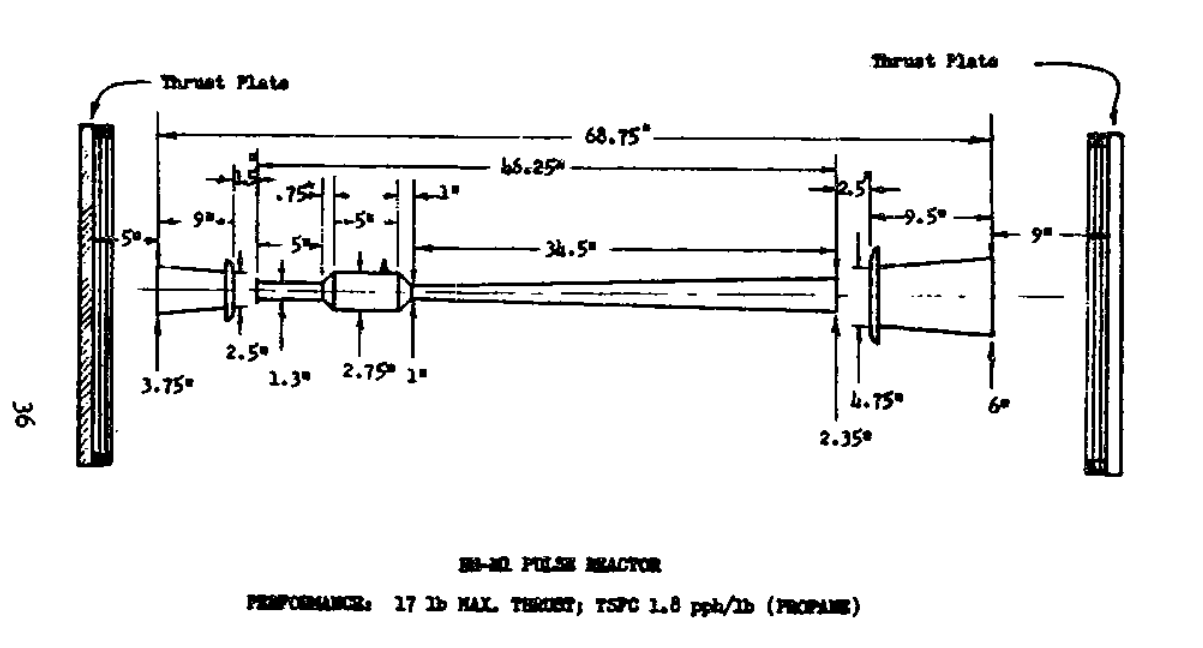
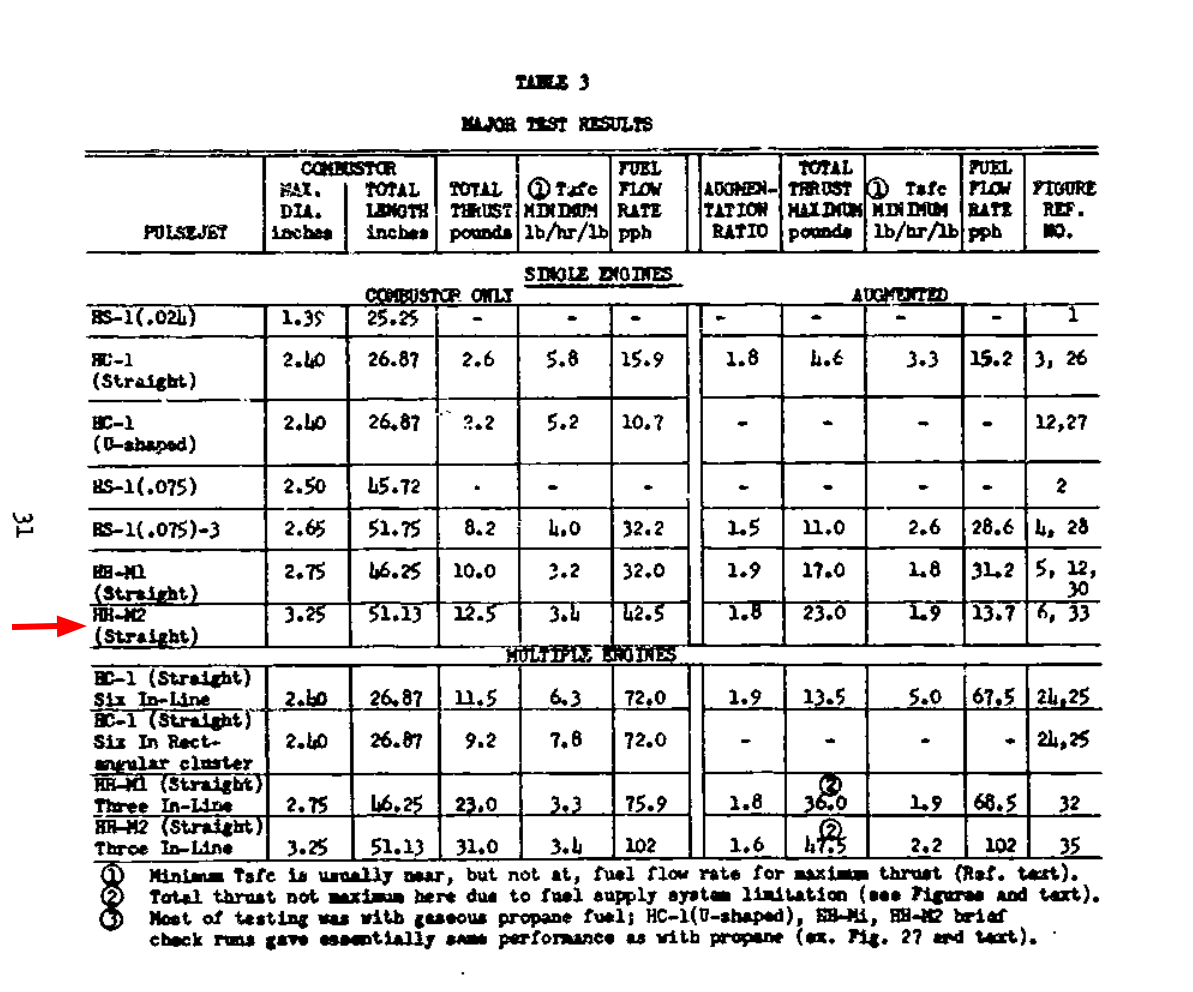
Picked this one (I think it was this one?) because it was straight, valveless, and had actual performance data associated with it.
CAD
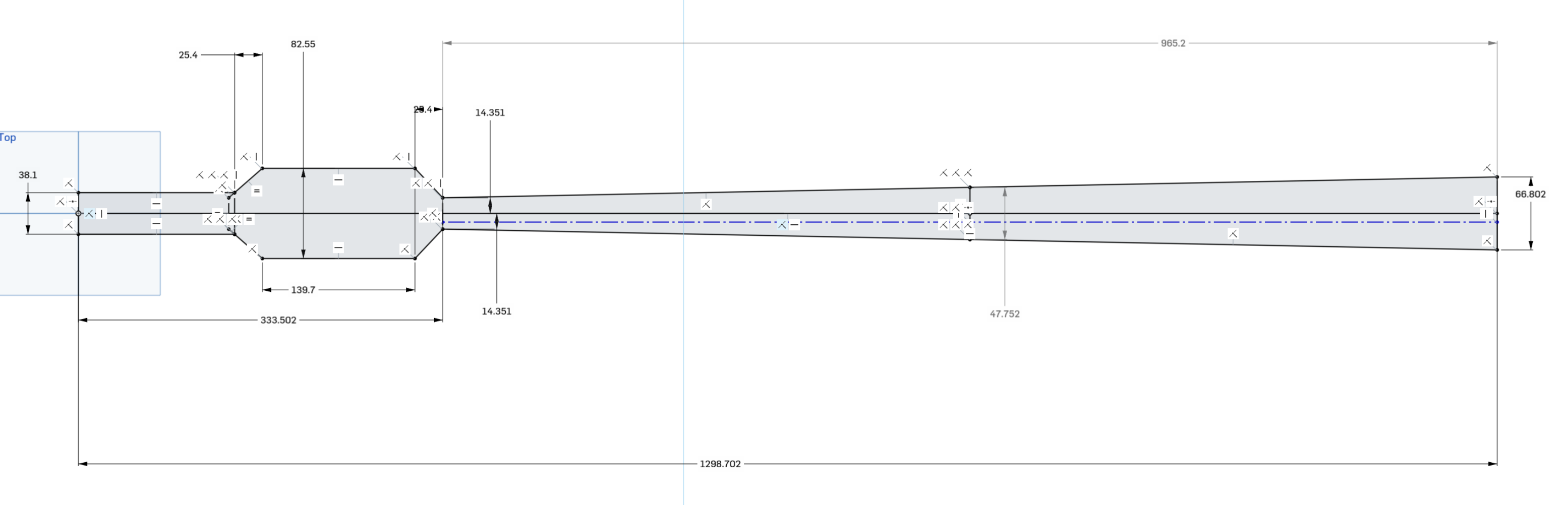
This got ordered from sendcutsend - the inlet and two tail sections were just ordered as three copies of the outer tail section to save on bom cost, and also that gets a bunch of scrap material for later:

Combustion chamber welded up
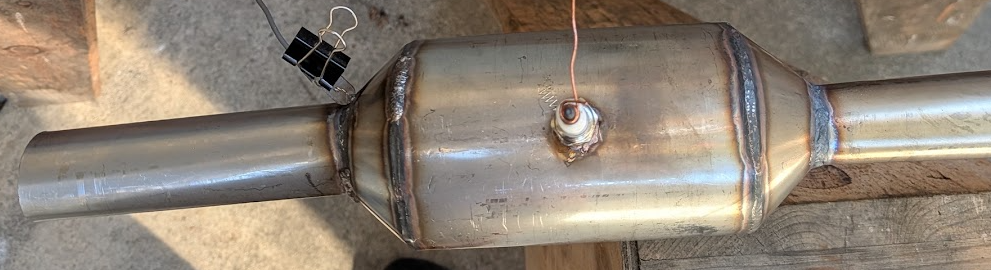
This was done with a couple kw laser welder. Makes things pretty easy.
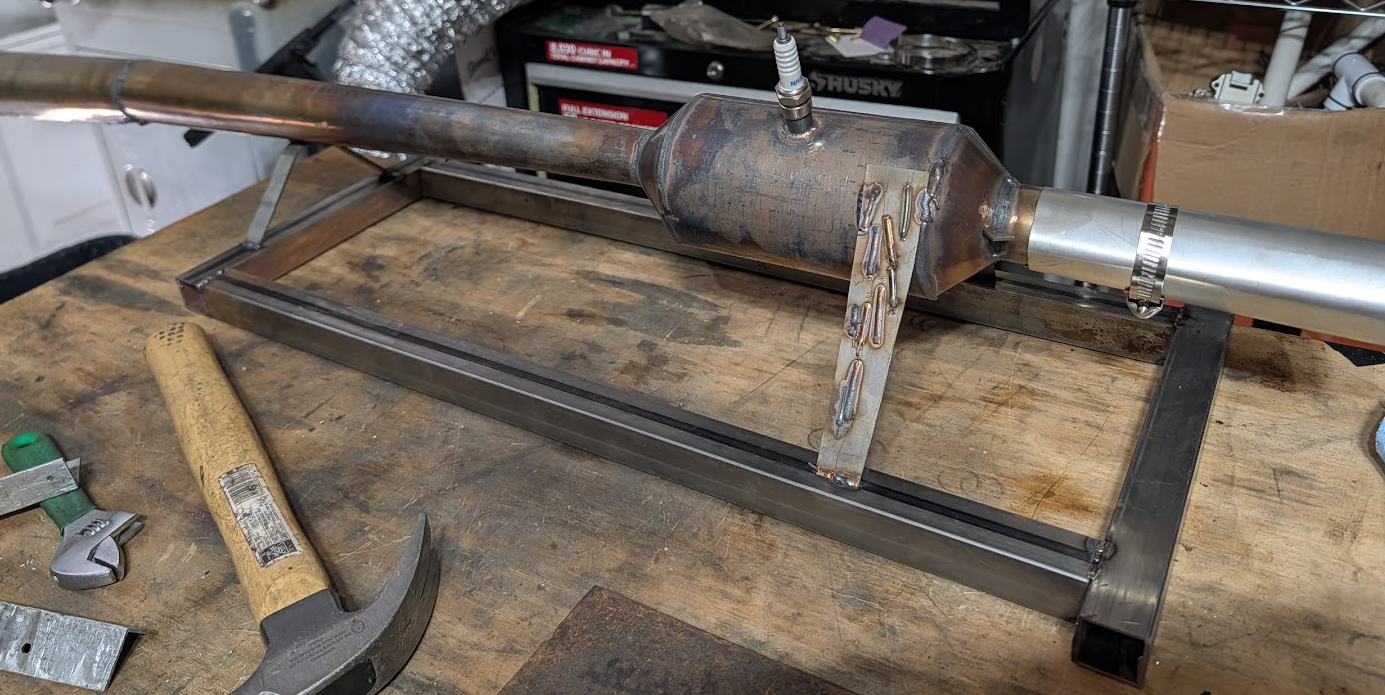
On a stand
Extra high emissivity paint
One idea for observing where the combustion is happening is to just look at the device with a thermal camera. As it is, however, the shiny metal surface is no good as it’s too reflective. But a quick coat of a magnetite/bentonite slurry gives good results:
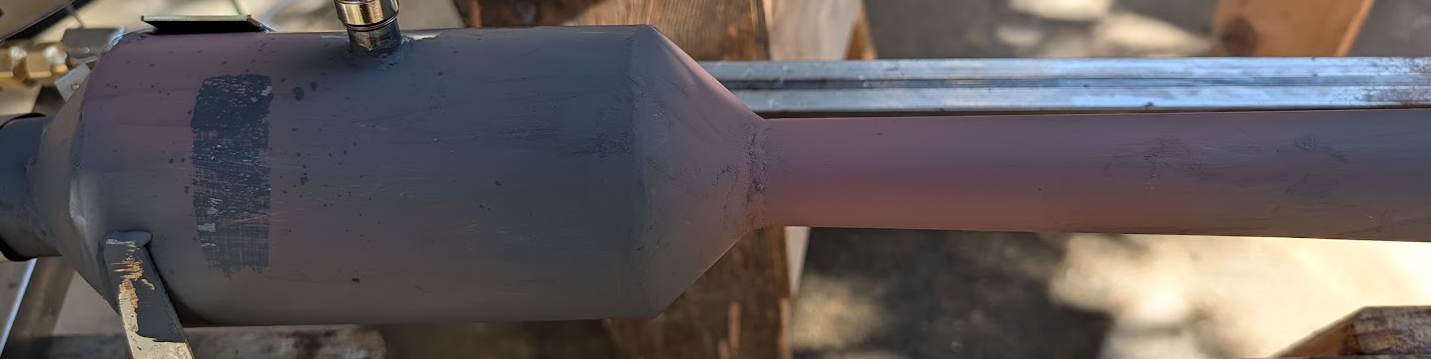
In the above picture you can see that the area just after the combustion chamber somehow got partially converted from Fe3O4 to Fe2O3. Although it’s clearly because it reached a higher temperature, interestingly it seemed to only occur after the heating during the cooling stage when the vessel wall was only a couple hundred C.
Stability, or lack thereof
This is where we ran into troubles. The pulse jet can be started if the fuel injection tube is positioned in the right location. The right location seems to be just inside the combustion chamber, with the fuel injection tube pressing up against the wall of the chamber, not in the center. Why? I don’t know.
Slow motion (1/8x) speed flame combustion
Doesn’t really look like there’s much to learn here.
On starting with and without a compressed air nozzle
We were starting the pulse jet using a compressed air gun as a source of air as opposed to a leaf blower or ducted fan. Interestingly the pulse jet starts up well when the restriction is used on the end, but not when it isn’t:
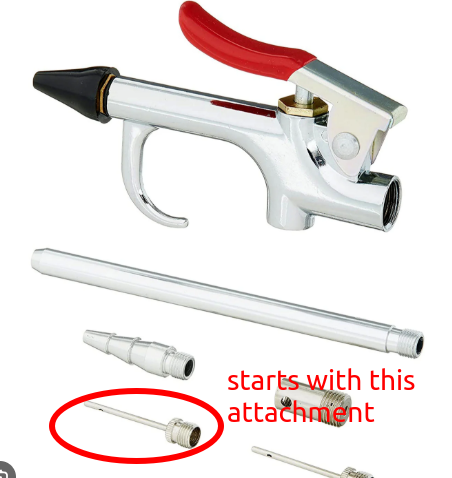
This could be either because the narrow jet of air is more turbulent and does a better job of fuel-air mixing, or (more likely) just that the fast jet entrains more air in a venturi effect and so more is delivered down the inlet of the pulse jet.
Pressure sensor idea
The academic literature generally uses piezo transducers to measure the pressure waves at a number of points across the combustion chamber of a pulse jet. There is a problem with this though:
- A piezo element is inherently sensitive to vibrations, since as you accelerate it back and forth a force is placed across it
- The wall of a pulse jet is subject to huge vibrations Hence, the piezo element will pick up a large signal that is of the same frequency of what you are trying to measure. If you aren’t careful in isolating and calibrating out the signal you want the results will look quite plausible and be completely wrong. Most pulse jet papers that have a waveform in them of the pressure at various points in the combustion chamber, for example the german one that is so promising for supersonic operation. But unless they account for this the results will be garbage most likely.
So how about this idea:
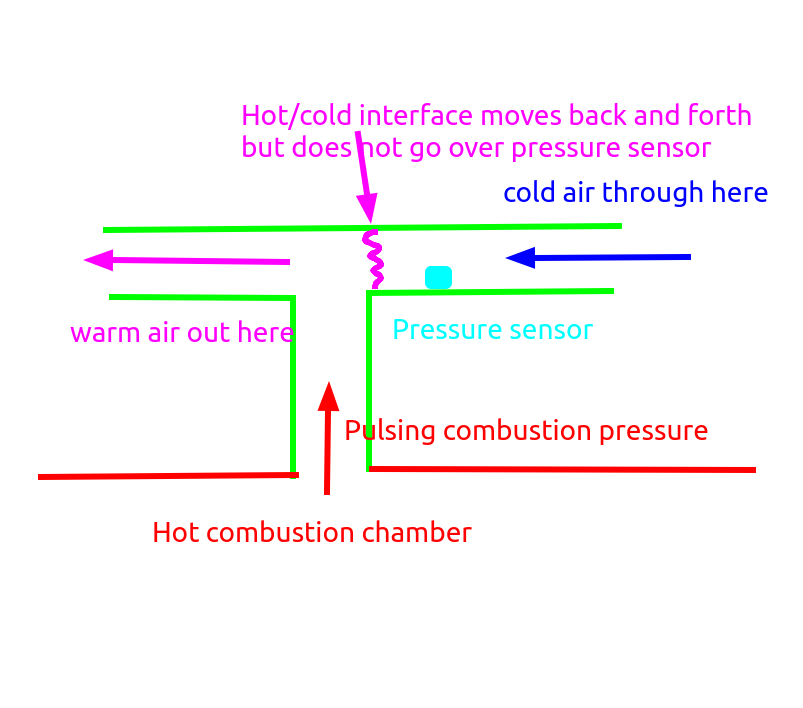
I feel like this could actually work. Mr claude of course agrees, but I did not find its analysis convincing.
However it does have the problem that you have to make a new one for each new location that you want to measure the pressure at.
Pressure sensor idea 2
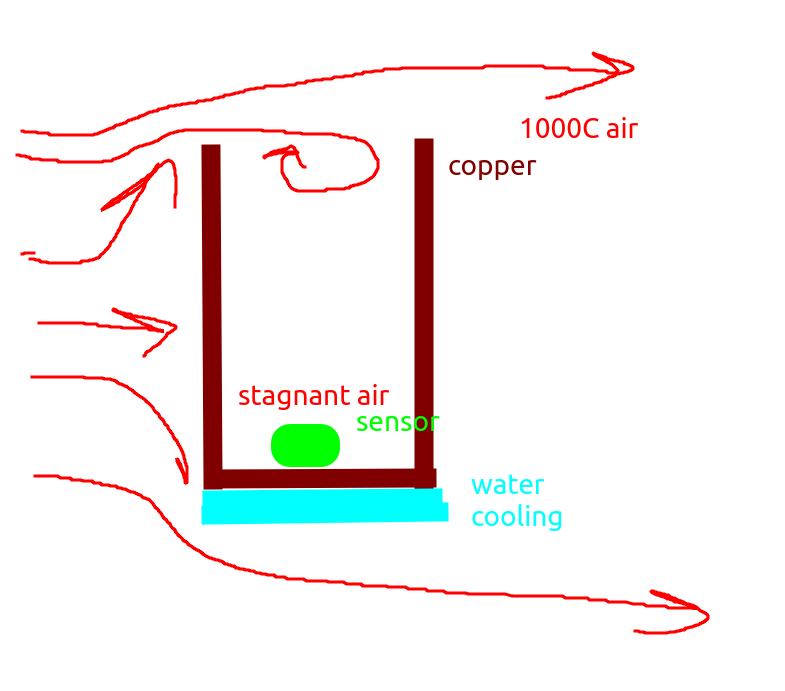
A better idea that was suggested to me would be to have a pressure sensor on the end of a stick, and then sweep the stick down through the pulse jet. The pressure sensor would of course have to be water cooled somehow, but the idea here is that if you put the pressure sensor down the end of a tube with a long enough l/d ratio, then maybe the airflow at the bottom would become stagnant, and so the head transfer into a small sensor at the bottom would not be that bad. Something like this:
Pressure sensor idea #3
I buy a noncooled pressure sensor like this one, a XCQ-093-50SG and stick it in a cooling jacket. Like this:
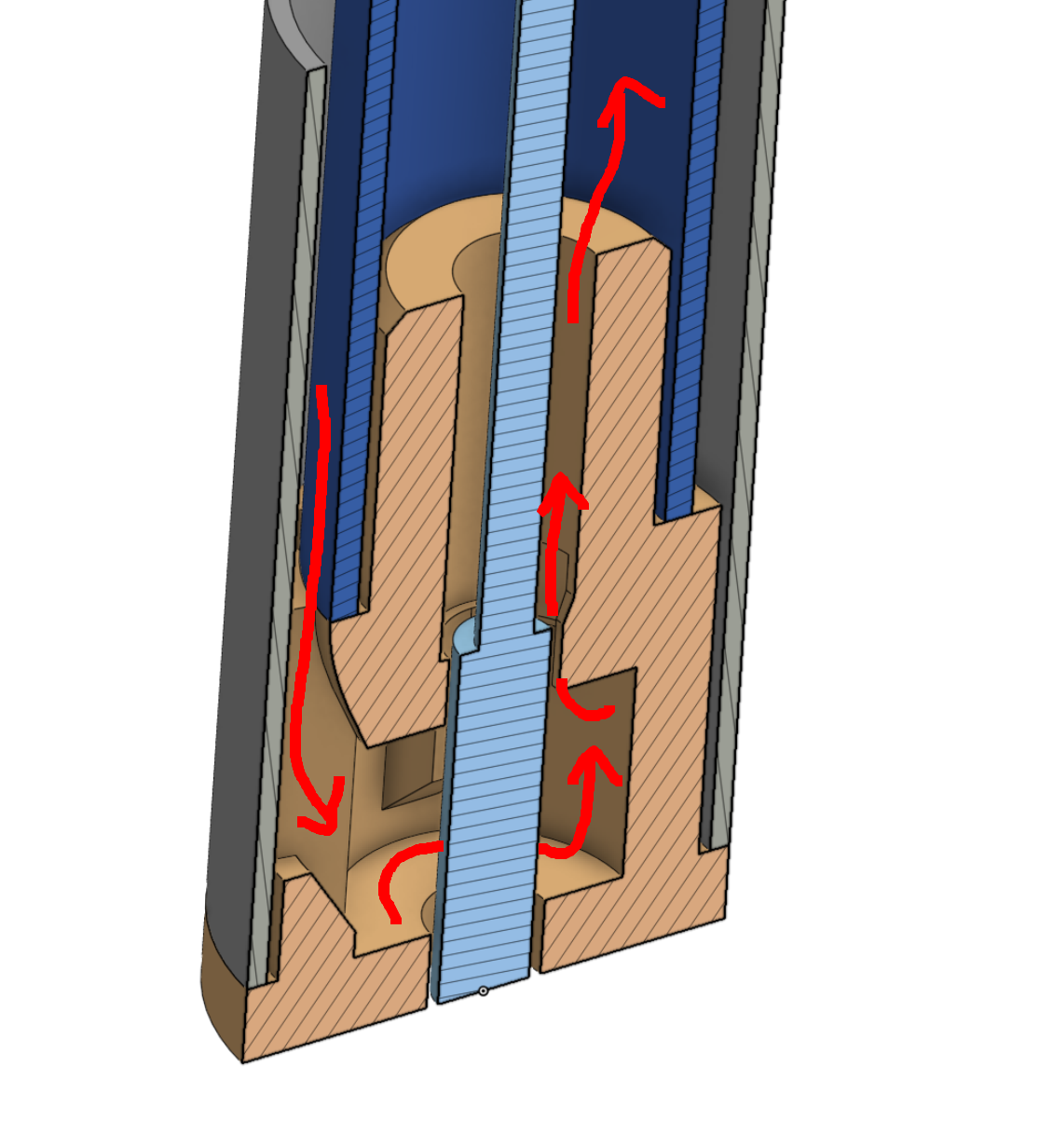
The orange part above can be printed from stainless steel for cheap, and goes inside two stainless steel pipes. The wire for the sensor will go all the way up the center pipe. At the other end of the pipes I’ll 3D print some doodad to enable water in/out + electrical connections. Then, since the whole thing is a 1/2” rod basically, hopefully it can be swept down the combustion chamber whilst the combustion chamber is running and the direct pressure vs axial distance function can be obtained (with the aid of one external microphone to get a phase reference.)
Provided that the pressure sensor does not interfere with the operation of the pulsejet this will be far superior to the “3-4 monitors going through the case” tactic that most people seem to use.
Simulation
I gave the above section alongside the relevant step files to Mr Sol medium and told it to calculate the flow resistance. It came up with this interactive 3D CFD report.
You can see from it that there is a constriction at the three vents that lead to the outer annulus for the return path (point 2) and also at the construction where it has to go around the actual sensor (point 1):

These results actually look pretty good - this is the first time I’ve gotten useful one-shot CFD results out of a model. You can see that a lot of the pressure is being dropped around the three slots that connect to the outer annulus of fluid, so I increased their size by a lot and put a small taper at the top:
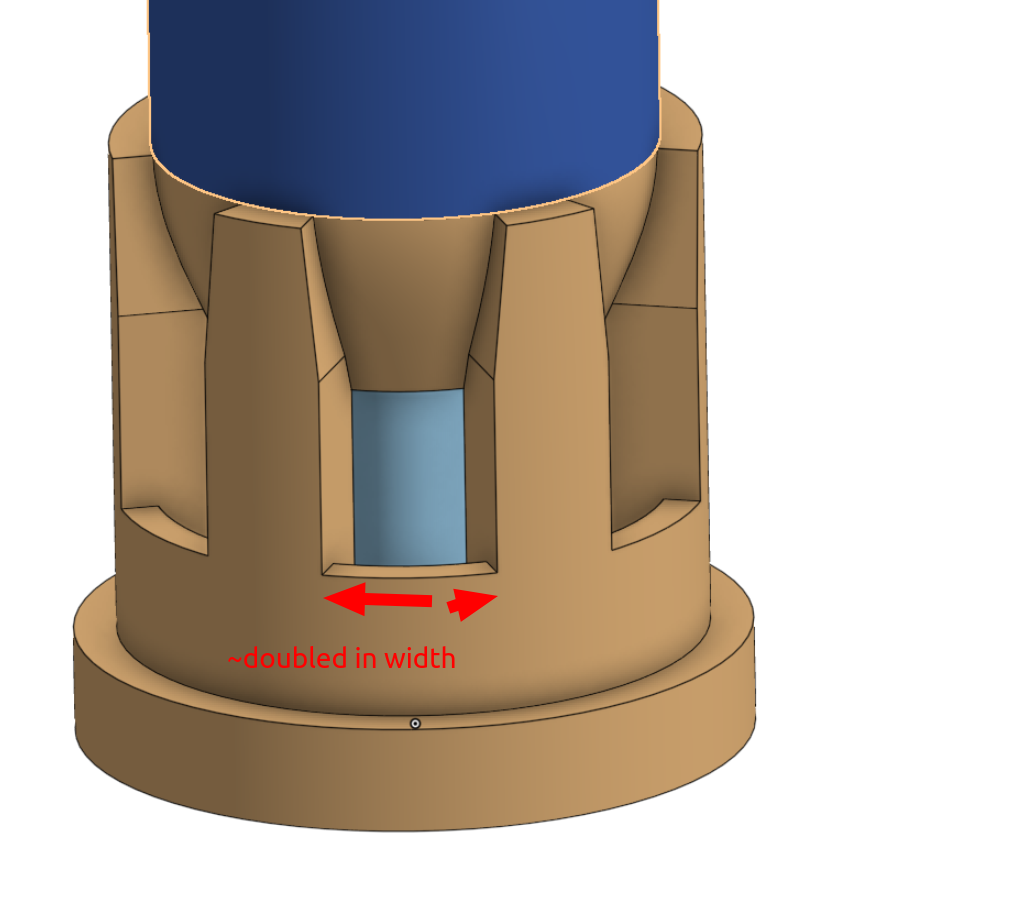
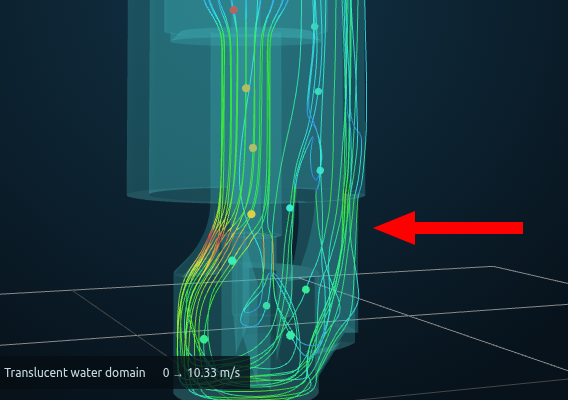
Re-running the simulation gives these updated 3D CFD results. You can see now that the previous restriction is gone:
Clearance vs press fit
I had originally intended the tubes to be epoxied in place, but perhaps that won’t work out for thermal reasons. So I added a variance that does a press fit on the end:
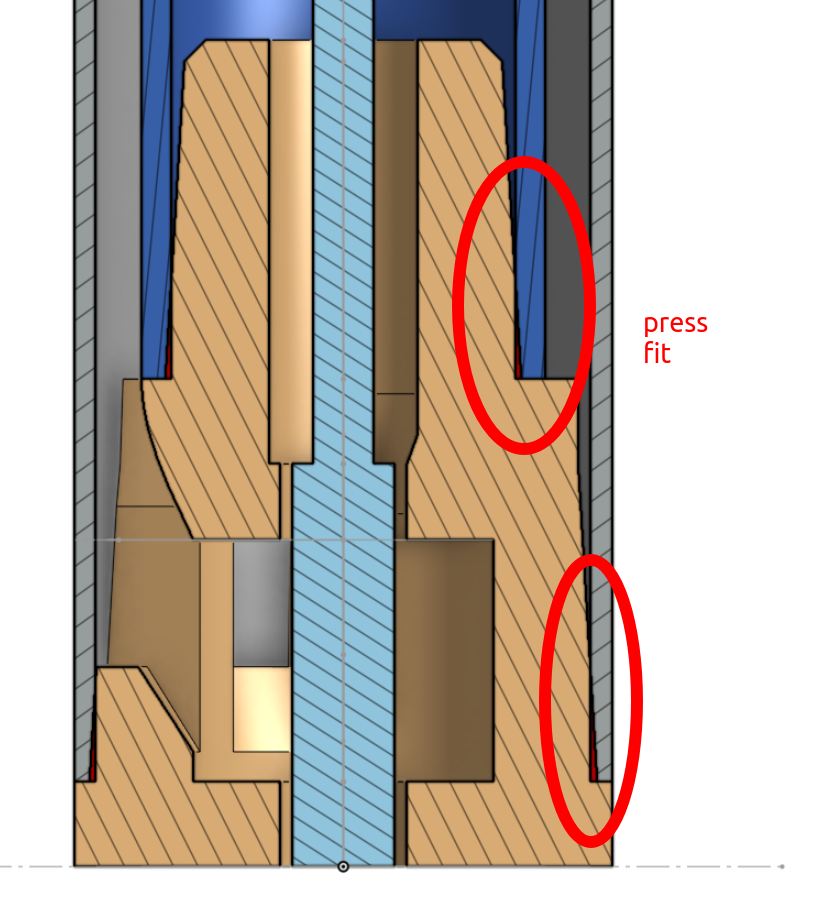
Hopefully we can rescue the design if the gluing doesn’t work out.
Experiment jot down.
Some quick experiments we did whilst waiting for the 3d printed parts to arrive.
Measure thrust
Run a strain gauge to try and measure thrust whilst the pulse jet was operating. There was ~0 thrust of course and the web app served by the esp32 was super slow and flaky even after claude worked on it a while trying to get good retransmission and dropout resilience. So I’m switching to a good ol serial port to a computer.
Measure effect on operation with a dummy sensor
Get a 1/2” rod (the same diameter as the real pressure sensor will be) and stick it gradually down the throat of the pulse jet whilst it was operating, to see if it would affect its operation. It didn’t stop it from operating and in fact made it work quite a bit better (or at least louder) in some locations. When you look at the actual construction of the pulse jet:
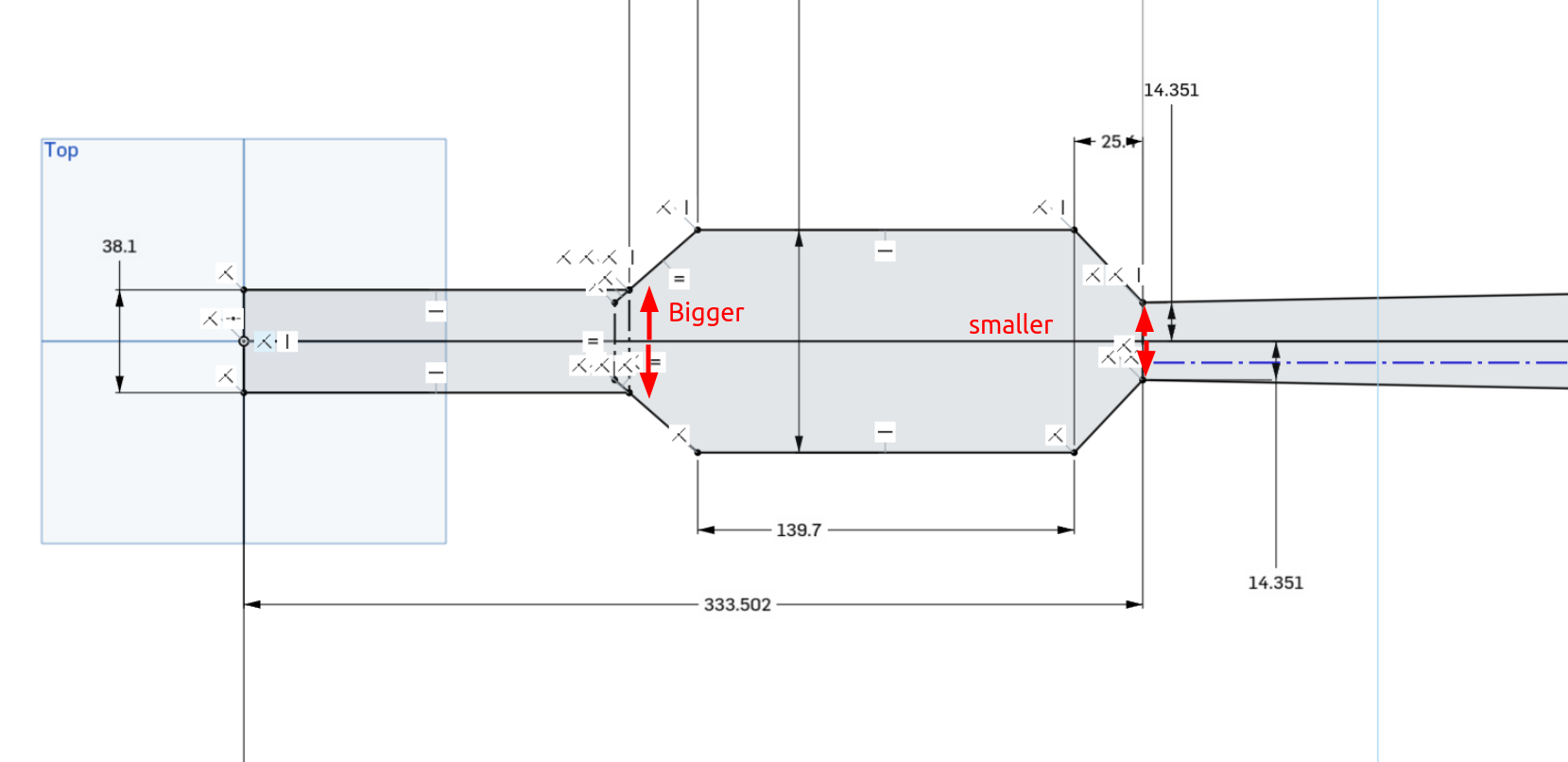 For some reason the outlet is bigger than the inlet. That seems odd and pretty unintuitive to me, but sure enough the Chosen design above has that. Worth searching about and seeing why this is the case.
Heat transfer
We didn’t have a proper thermocouple meter, but we did have a thermocouple. Got a 1/2” copper pipe, and put a smaller copper pipe down it with a thermocouple taped to the end. Flowed water down the inner pipe and out the outer pipe. Blasted the engine and tried to measure the thermocouple voltage. Got to about 0.3mV. But the water flowing back out was pretty warm to my hand, probably at least 40C. What does this mean? It means bring a thermocouple reader next time. fwiw mr GPT says that 0.3mV corresponds to 32C, which is in the right ballpark.
Data collection
Test setup:
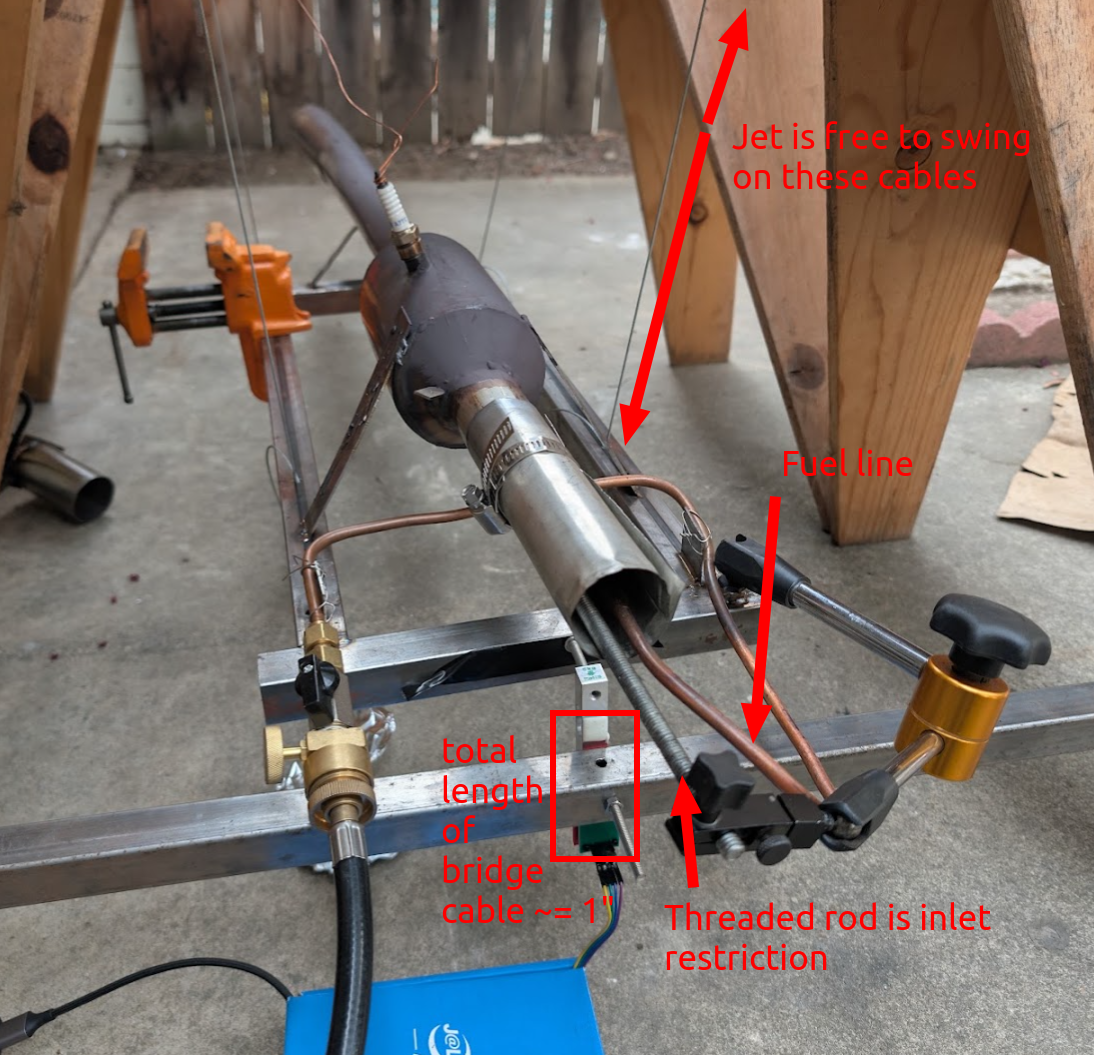
Data
I ported the previous data collection system from streaming to a web app over the esp32’s wifi connection to a serial port. Unsurprisingly this is much more reliable. However, there are still quite a lot of data dropouts when the spark plug is running, visualised here:

Unlike last time though when the spark plug is turned off, data is streamed without loss when the pulse jet is operating (spark plug is only required for startup). So this means that we can finally get a first official measurement of the thrust of the pulse jet:
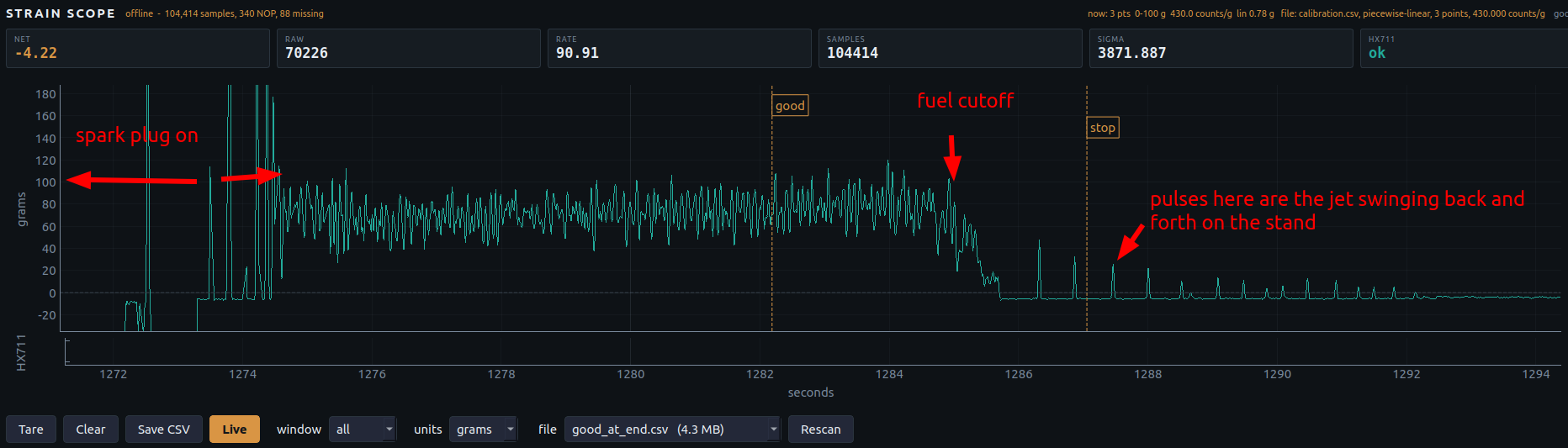
A whole 80g of thrust! 40% of the thrust in a straight-tube configuration apparently comes out the inlet, so this means that the “gross” thrust is probably ~80*1/(0.8-0.6) 400g. that’s kind of in line with what’s plausible.
Inlet restriction.
You can see from the above test stand photo that there is a threaded rod jammed down the inlet. In fact the threaded rod has a nut+washer on the end of it. If you position it in just the right location (and the fuel line of course) then the jet is able to operate by itself with no compressed air assistance indefinitely, which is the first time we’ve gotten this far. In hindsight this kind of makese sense because you would think you would want the inlet smaller diameter to the outlet. But hindsight is no basis for an engine program and so I think a good next step here whilst waiting for the water jacket 3D print to arrive is to take a look over the literature and try and find design rules of thumb, debugging techniques, etc to help build intuition as to what design change should be made. Currently we just wiggle the fuel line around until it’s just right to get it to operate but I don’t think we can do that all the way to a supersonic airplane.
Water jacket preliminary results
3D printed endcap
The prints came back, and they look pretty good:
There are some parts of the model that didn’t quite meed the design rules of jlcpcb, but everything looked fine when I got it.
Delivering the water.
Here is the print for delivering the water down the jacket
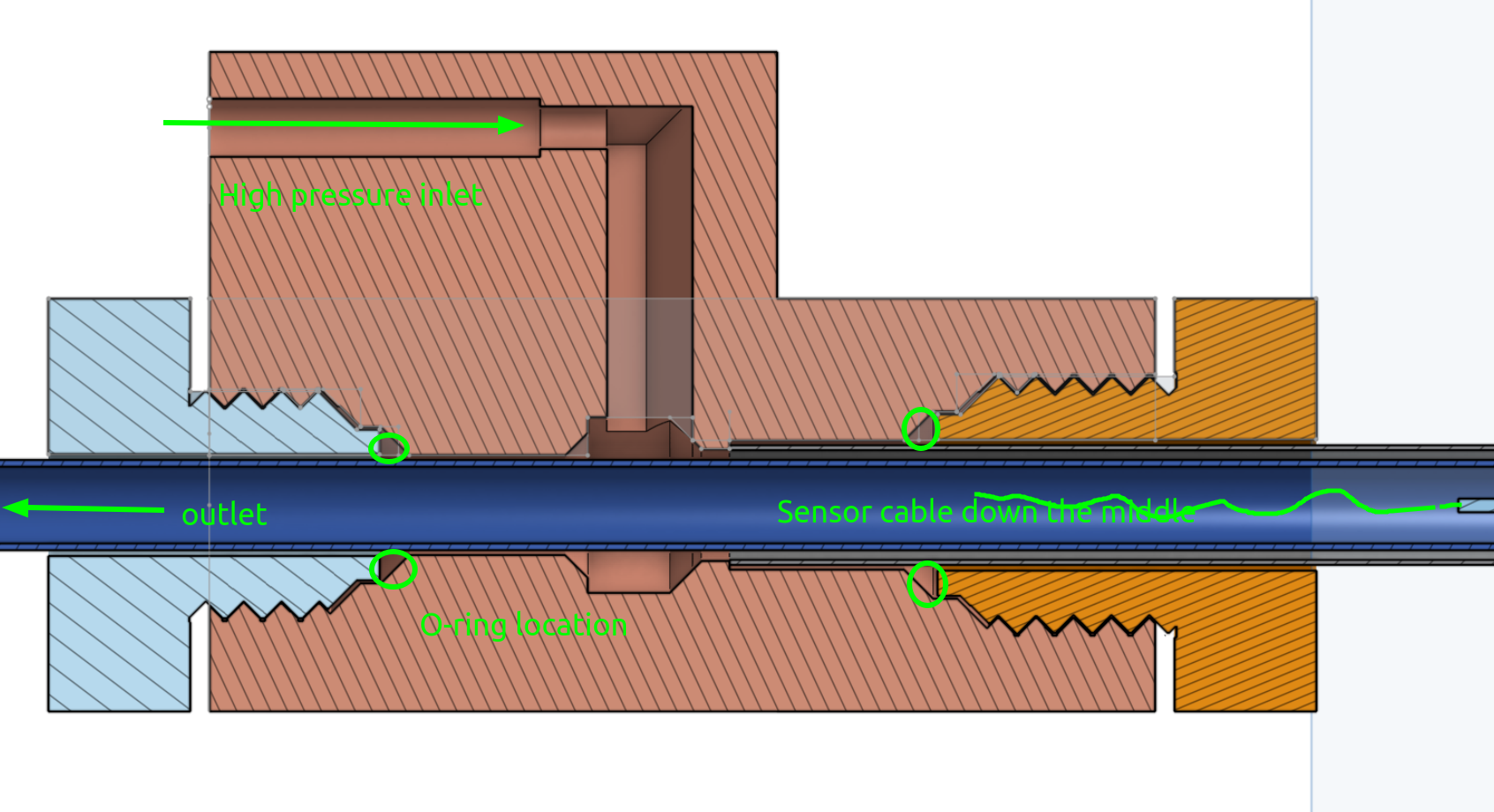
The cold side of the water loop is delivered to the outside jacket, which is a bit unintuitive because that’s the side that is exposed to the flames of the combustion chamber. But, a) This means I don’t have to seal around the pressure sensor cable on the high pressure side, and b) Probably since the incoming and outgoing streams are in such good contact, they end up at thermal equilibrium by the time they get to the tip anyway.
Here it is in the real world:
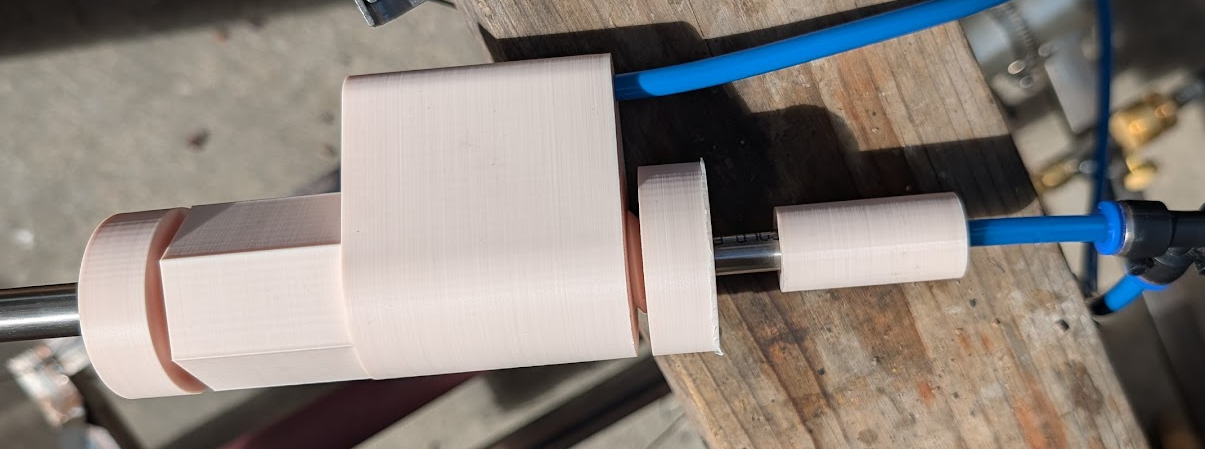
The only problem with this kind of print is that FDM printing is not watertight at all, so the setup is a bit drippy. But that’s OK, it does not affect the actual operation.
Cooling loop test
Instead of sticking the expensive and irreplaceable pressure sensor in the end of the probe per the final design intent and having it immediately burn up, I figured I would stick a thermocouple where the sensor is supposed to go like this:
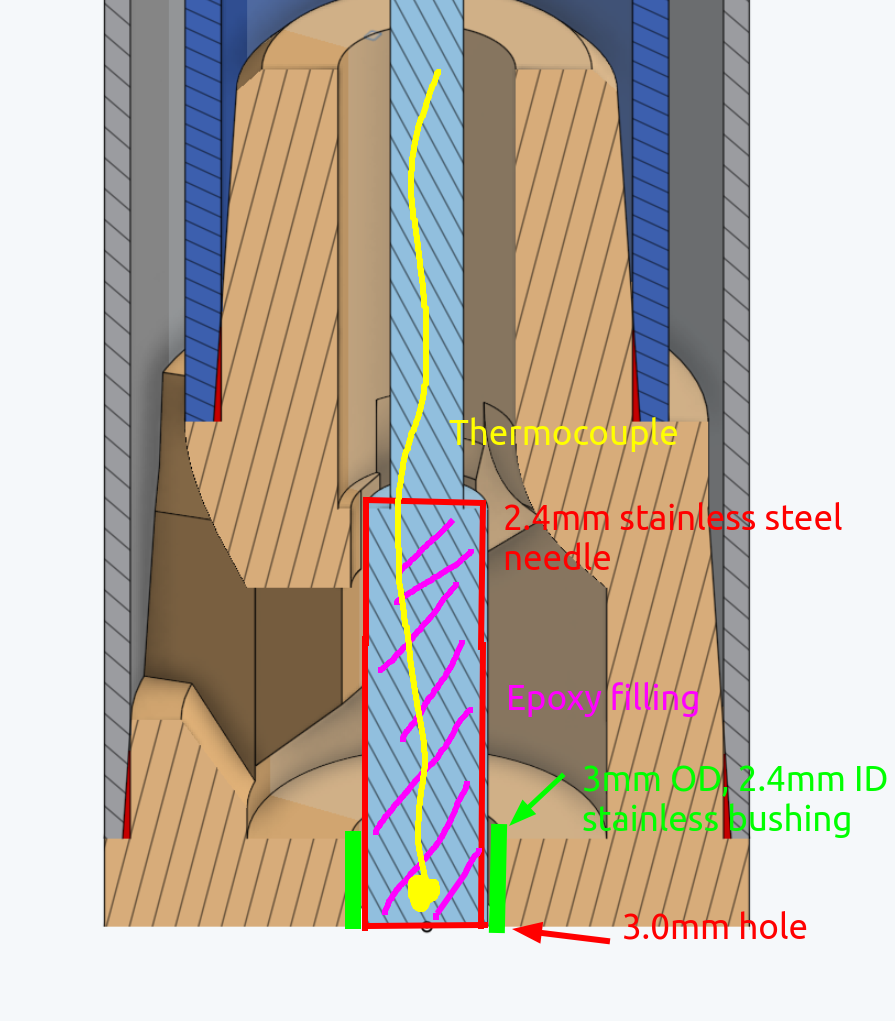
In the above diagram there is an extra sleeve that goes between the pressure sensor and the 3D print. This is because the tolerances that were listed on the JLCPCB website were 0.3mm for this type of 3D print, and I wanted to ensure a clearance fit for the 2.4mm diameter pressure sensor so I opted for a 3mm hole. This was in retrospect silly. I should have put a 2mm hole in the design and simply drilled it out to the right dimensions when it came in.
The thermocouple-in-place-of-pressure-sensor experiment is a conservative one, I think. Since the thermocouple is sitting inside of regular epoxy, the thermal resistance to the case is quite high, or higher than you would expect for the actual pressure sensor which is predominantly metal and silicon.
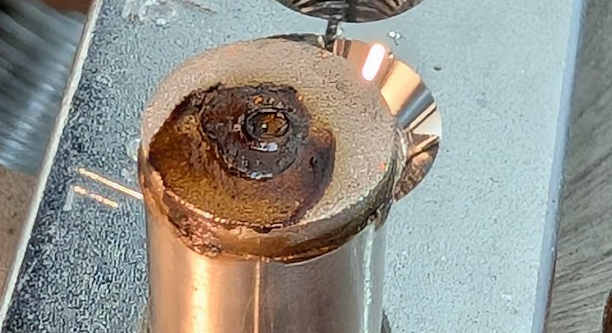
Regardless, the test was a complete success. Operating in the heart of the combustion chamber, whilst the pulse jet was glowing red hot, the thermocouple got to around ~105C. The outside looks a little toasty but that’s fine:
Assembly of the jacket.
In the above [diagram you can see the press fit in the CAD, the small red triangles. I had one part printed like that and two printed straight with the 0.3mm clearance fit. With the arbor press though combined with gripping the pipe with
Measuring the temperature using the pressure sensor directly.
Apparently the overall resistance of the kulite pressure sensor changes quite a lot with temperature, so for a known drive voltage if the current going through it is measured this can be used to calculate what temperature it’s at. Presumably this will need to be calibrated, but that’s fine. Even if the measurement isn’t super great this is still a good way to know how close to the limit the sensor is operating.
Final assmbly
Since the thermocouple-only test went well and I now have a reasonably good (to a few deg C) temperature measurement of the pressure sensor using the sensor itself, it’s now time to put it together. I took advantage of the fact that the hold in the 3D print was 3mm and the sensor was only 2.4mm in diameter to put in a shim sleeve of stainless to offset the tip of the sensor inside the water cooling loop:
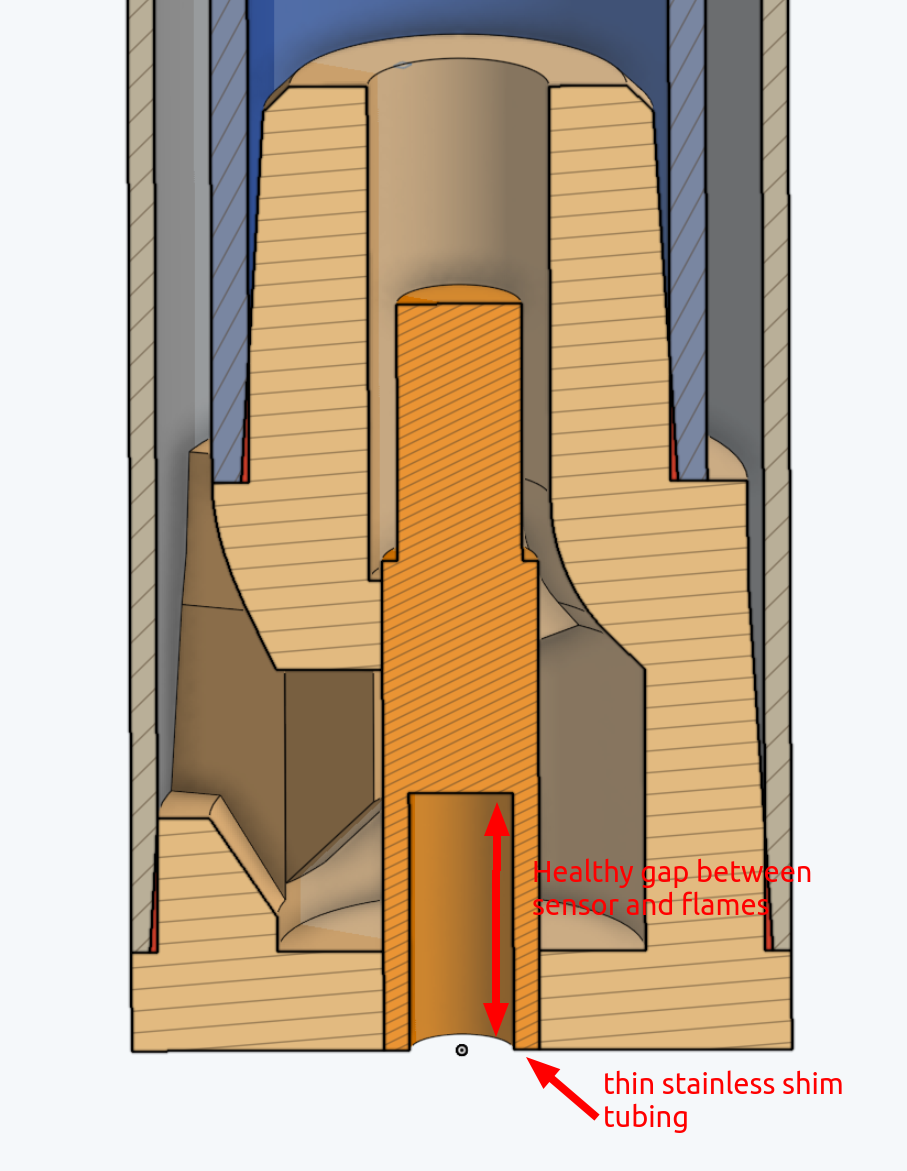
As with quite a few other things, I should of course have done this to begin with. For this print it also pushes the sensor up into the water exit area, restricting the water flow quite a bit but there was also quite a lot of margin there in the earlier simulations so hopefully this is OK.
Assembly
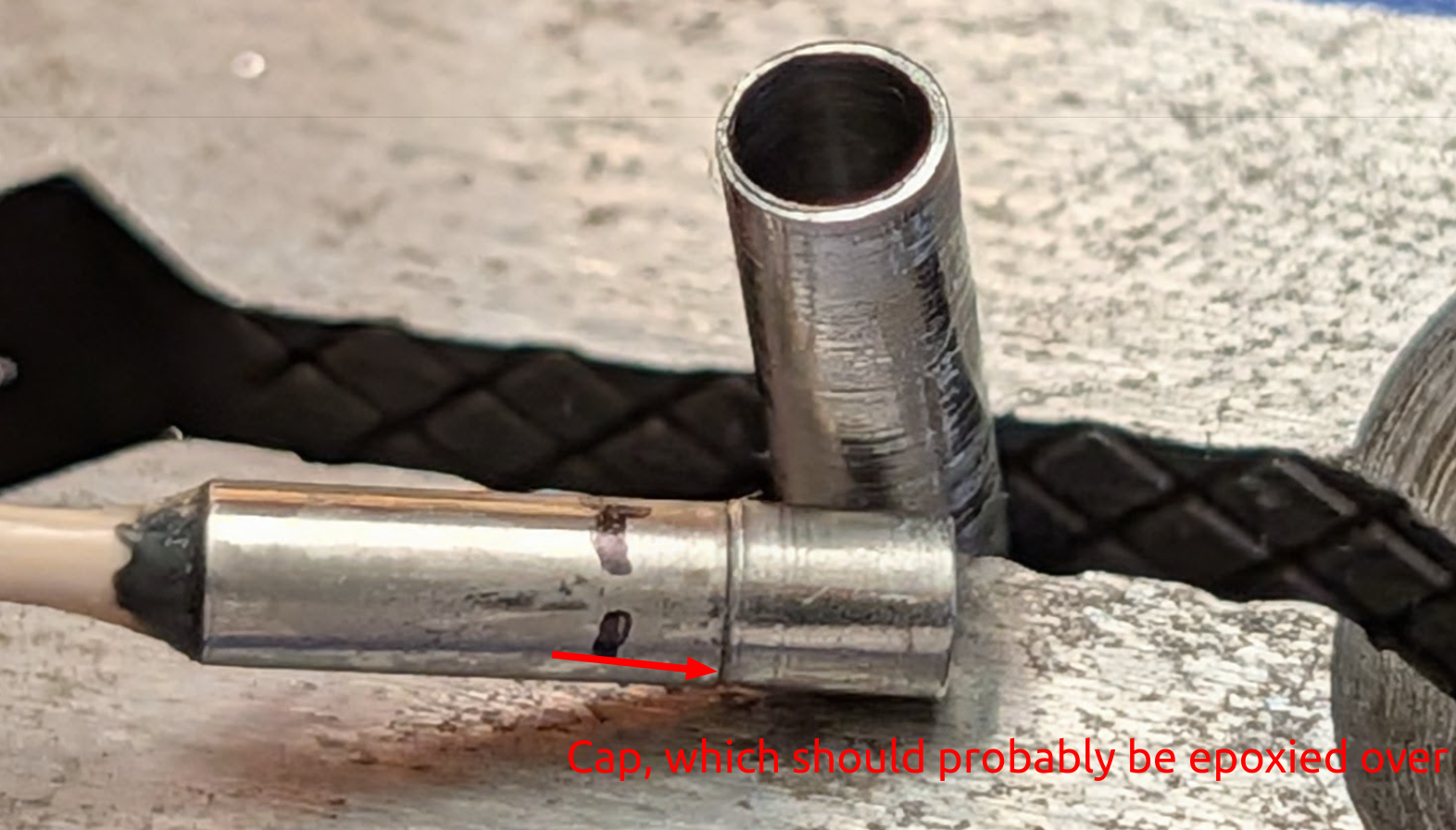
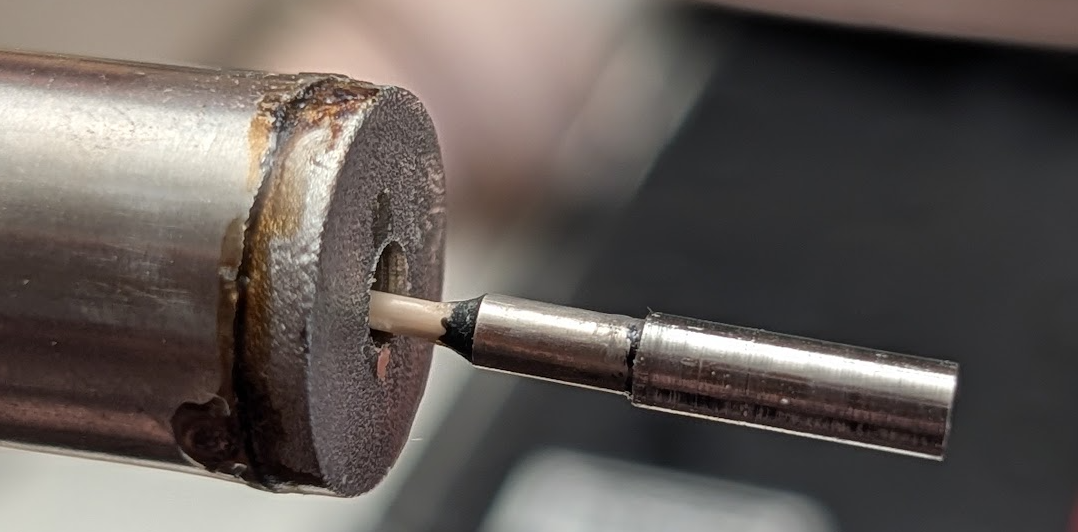
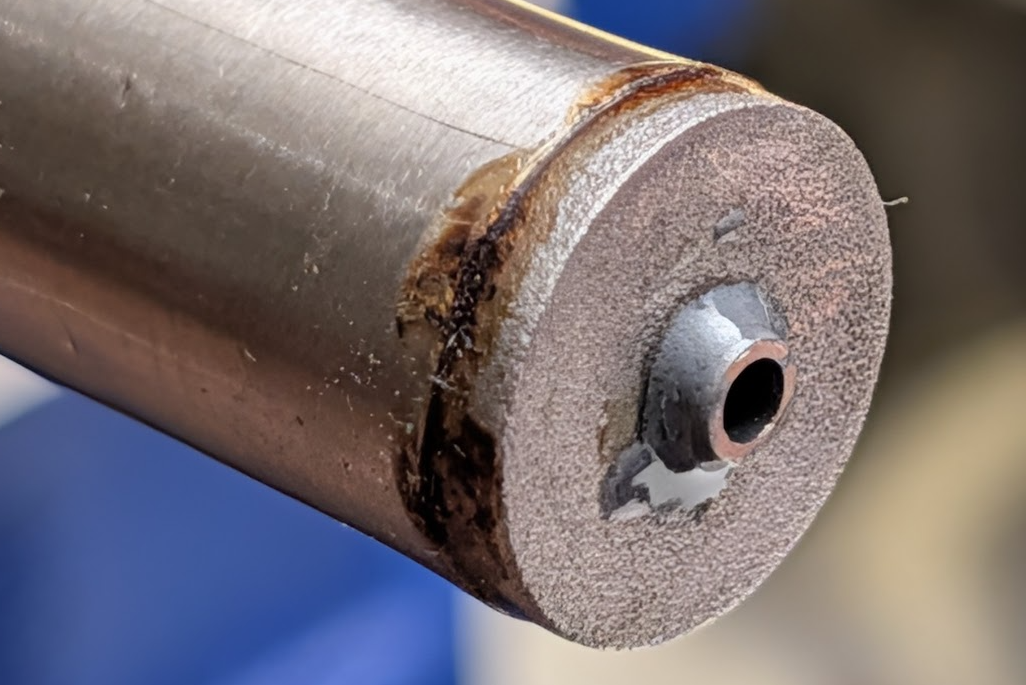
Per the results here the end of this sensor is actually a cap. I don’t want water to get all up inside it, so epoxying past this line seemed like the right move.
Press fit comes apart
Somehow the inner tube fell off the 3D print, even though it was pressed on there pretty good. I think this was because the water block print on the end actually allowed the inner tube to wiggle back and forth, which of course has a huge moment arm. So the 0.2mm nozzle on the printer was used to put this in:
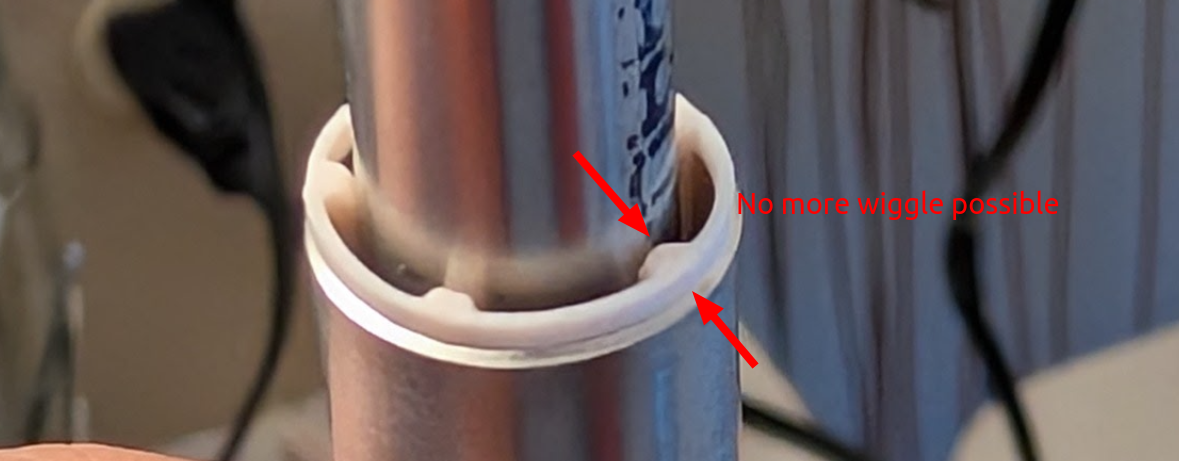
Which effectively prevents side fumbling.